Your RevOps team isn't lazy. Your Sales reps aren't unorganized. Your CS Managers aren't "slow" at responding to tickets.
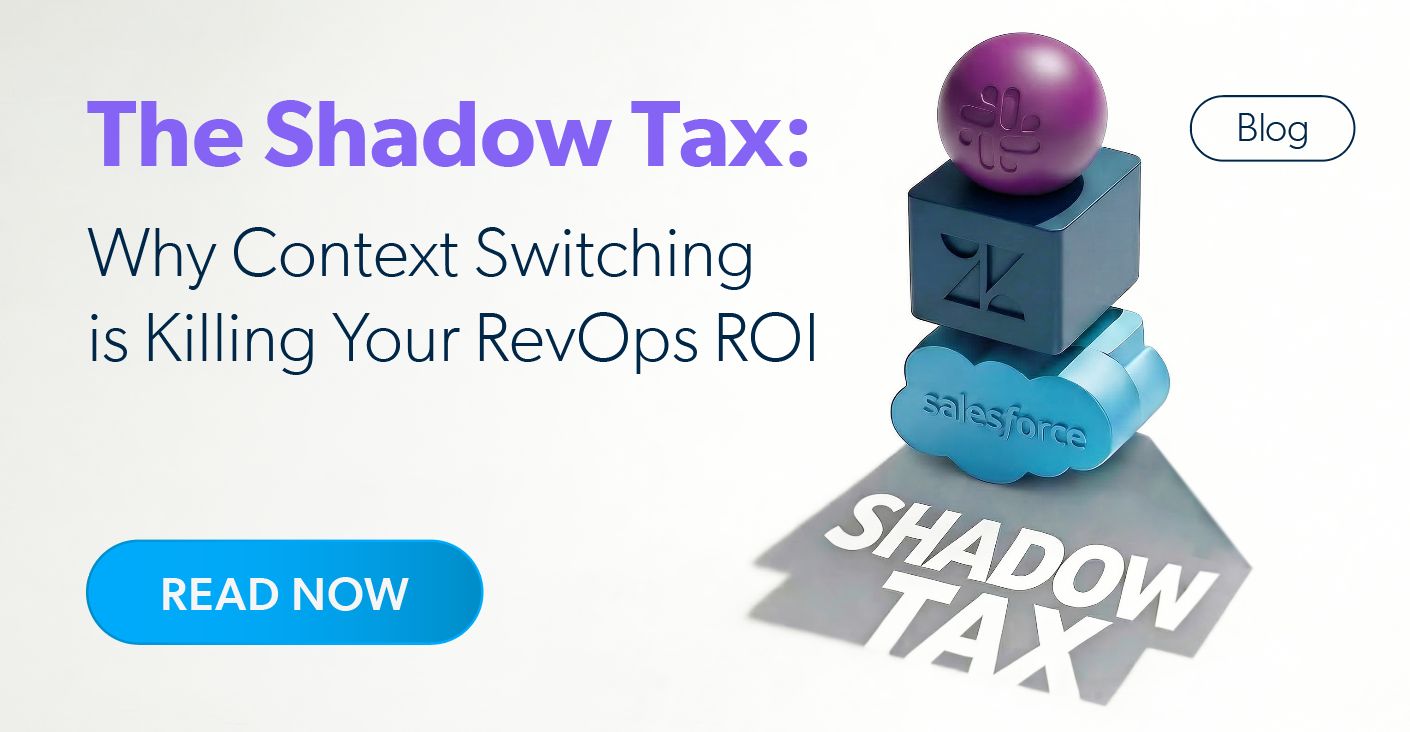
The reality is much more systemic: they are victims of a Shadow Tax.
In the modern enterprise, we’ve spent the last decade building a "best-of-breed" tech stack. We have Slack for communication, Salesforce for the "source of truth," Zendesk for support, and a dozen other niche tools for everything from prospecting to churn modeling. On paper, this is a dream of granular data and specialized efficiency.
In practice, it has created a cognitive nightmare. We’ve traded deep work for a constant state of Alt-Tab Fatigue. This isn’t just a minor annoyance; it’s a productivity killer that makes work take twice as long and costs companies millions in "leaked" revenue.
To understand the cost of context switching in RevOps, we have to look at the cognitive science behind it. Research from the University of California, Irvine, suggests that it takes an average of 23 minutes and 15 seconds to get back to deep focus after a distraction.
Think about a typical RevOps Manager’s morning:
That 5-minute Slack interruption didn't just cost 5 minutes. It cost 28 minutes of cognitive momentum. Multiply this by 50 interruptions a day across an entire GTM (Go-To-Market) team, and you start to see why "Operational Drag" is the silent killer of growth.
In RevOps, the context switching usually happens across three primary silos. Each has its own flavor of friction:
Slack was supposed to kill email. Instead, it created a culture of "immediate urgency." For RevOps, Slack is where the "exceptions" live. It’s where data goes to die in unsearchable threads. When a RevOps professional has to jump from a strategic project into a Slack thread to explain a commission structure for the tenth time, the "Time Tax" is paid in full.
The CRM is the "System of Record," but for many, it feels like a "System of Data Entry." The friction here is the Information Gap. To get the full picture of an account, a rep has to click through five different tabs, look at activity history, and hope the last person left a decent note. This "detective work" is context switching in its purest form.
When support tickets are siloed away from the sales view, the friction becomes external. A Sales rep goes into a renewal meeting "blind" because they didn't check Zendesk to see the customer has had three outages this week. The context switch here isn't just about time—it’s about credibility.
When you force your team to jump between tools, you aren't just losing time; you're losing accuracy and energy. This creates what we call "Operational Drag."
The RevOps Reality Check: If your team spends more time finding information than acting on it, your tech stack isn't an asset—it’s a liability.
We can actually put a number on this. If a RevOps professional earning $120k/year loses just 20% of their day to unnecessary context switching (a conservative estimate), that is $24,000 per year, per person in wasted overhead.
Across a 100-person GTM team, that’s $2.4M in "Shadow Tax" annually.
But the revenue cost goes deeper than payroll:
The solution isn't to buy another tool. The solution is to bring the context to the person, not the person to the context.
Modern RevOps leaders are moving away from "Tool Sprawl" and toward Unified Visibility. They are looking for ways to surface the right data, at the right time, in the right place. This is where the concept of the Meeting Prep Packet or "Automated Intelligence" comes in.
Imagine a world where, instead of "detective work," the information finds you:
If you want to reclaim your team’s productivity, start with these three steps:
RevOps is the backbone of the modern revenue engine. But even the best engine will seize up if it's filled with the grit and sand of operational friction.
By identifying the "Shadow Tax" of context switching and investing in better visibility and preparation, you aren't just making your team faster—you're making them more strategic. You’re giving them back the one thing Silicon Valley can’t buy more of: Time.
When you eliminate the scramble, you empower your team to do what they were actually hired to do: Drive Revenue.
Ready to stop the scramble and start winning? Take a look at how we handle the "Time Tax" with automated intelligence. Learn more on a call with one of our GTM specialists here.


