We are officially past the honeymoon phase of the AI revolution, and the initial verdict is in: AI is here, and it is incredibly good at what it does.
Look at any screen in your tech stack, and you will likely see a little sparkle icon waiting to help you. We can now draft emails in seconds, summarize hour-long discovery calls with a single click, and generate complex code snippets before our coffee gets cold. The first wave of Artificial Intelligence fundamentally transformed how we work, delivering a massive injection of efficiency.
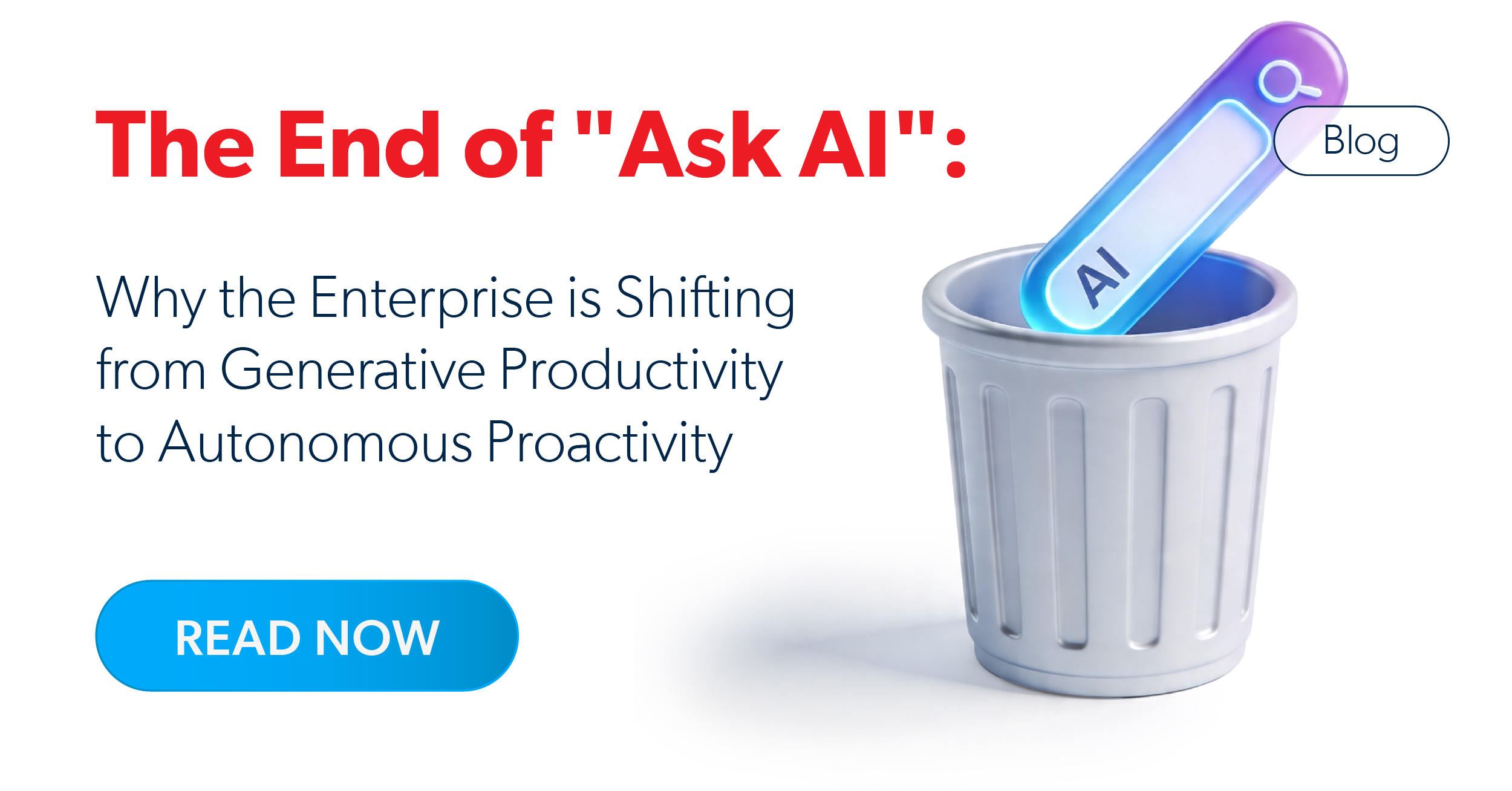
But as the dust settles on this initial wave of "Generative Productivity," enterprise leaders are waking up to a stark reality: getting tasks done faster is not the same thing as driving the business forward. The current paradigm of AI relies entirely on a passive architecture. It is an "Ask AI" world. The model sits quietly in the background, incredibly capable but entirely dormant, waiting for a human to type the perfect prompt.
But what happens when you don't know what to ask?
If a key champion at your biggest account quietly leaves the company, or if product usage drops by 15% across a specific cohort, your AI won't tell you. It will just wait for you to stumble upon the issue in a dashboard and ask, "Can you summarize this account's health?" By the time you realize you need to ask the question, the churn risk has already materialized.
The enterprise doesn't just need AI that answers questions faster. It needs AI that knows which questions need to be asked in the first place. We are moving from the era of Generative Productivity into the era of Autonomous Proactivity.
And getting there requires a complete architectural tear-down of how we deploy AI at work.
To understand the necessity of this shift, we have to look at the "data chaos" plaguing modern Go-To-Market (GTM) and operational teams.
Information is no longer centralized. It lives in fragmented tech stacks: Salesforce, Jira, Slack, Zendesk, Gong, and countless isolated dashboards. The sheer volume of enterprise data creates overwhelming noise. For a human to find the "signal"—the exact moment a deal stalls, or the specific week a customer starts exhibiting churn behavior—they have to constantly hunt across these silos.
Current AI tools act as powerful flashlights in this dark room. If you point the flashlight at a specific corner (by prompting the AI), it illuminates everything perfectly. But the rest of the room remains pitch black. The burden of discovery is still entirely on the human operator.
Relying on dashboards and reactive prompts means leadership is always managing through the rearview mirror. You are operating on historical data. By the time a metric flashes red on a CRM dashboard, the window for proactive intervention has often slammed shut.
The goal isn't to help a Customer Success Manager write a churn-prevention email faster. The goal is to alert the Customer Success Manager that the email needs to be written before the customer ever thinks about canceling.
The next wave of AI is not about a smarter chatbot. It is about an autonomous business partner.
Imagine an Always-On AI that functions as the central nervous system of your organization. A nervous system doesn't wait for a prompt to tell you that your hand is touching a hot stove; it constantly monitors every nerve ending, instantly surfacing critical alerts to the brain so it can react in real-time.
Always-On AI does exactly this for your business data. Instead of sitting passively, it continuously monitors the fragmented tech stack 24/7, sifting through the noise to capture revenue signals and mitigate risks across every department:
This is Autonomous Proactivity. It ensures that the enterprise isn't just "doing work faster," but is perpetually ahead of the curve.
If you take today’s most powerful Large Language Models (LLMs) and try to force them to be "Always-On," they break.
The current industry standard for connecting AI to enterprise tools is a combination of LLMs and frameworks like the Model Context Protocol (MCP). This works beautifully for a single, reactive question. But let's look at the math of continuous monitoring.
Imagine asking a single, cross-organizational question: "Which of our Tier 1 accounts are showing signs of friction today?" To answer this, a standard architecture must query the CRM, read recent support tickets, scan Slack channels, and check product usage data. That single question can trigger dozens of API calls and process hundreds of thousands of tokens.
Now, try to scale that. Ask that same AI to monitor hundreds of accounts, across dozens of tools, 24/7. Suddenly, you are triggering tens of thousands of API calls a minute. The compute costs become astronomical, and the latency makes the system entirely unusable. This is the Continuous Intelligence Bottleneck. Standard LLM architectures are simply financially and technically untenable for always-on organizational intelligence.
You cannot build a proactive nervous system on top of an architecture designed for reactive chat. Always-on intelligence requires a purpose-built infrastructure layer, not just a smarter model.
This is exactly why Jigso was built. We recognized early on that the barrier to proactive AI wasn't the intelligence of the models, but the infrastructure delivering them.
Jigso serves as a foundational AI Operating System for Work, designed specifically to unite fragmented enterprise tech stacks and eliminate data chaos. We have engineered a proprietary architecture that solves the Continuous Intelligence Bottleneck. Our infrastructure enables massive, cross-platform observability without the prohibitive compute costs or latency of standard LLM-plus-MCP frameworks.
With Jigso, your enterprise achieves an Always-On AI Observability layer that acts as the organization's nervous system. It delivers proactive insights and a true 360-degree overview of clients and projects across all data sources—and it can be fully operational in just 30 minutes.
Founded by technical veterans, including a CTO with a background in the elite IDF Unit 8200 and 27 years of enterprise software development and R&D leadership, Jigso is built on a foundation of battle-tested engineering.
By replacing intuition and manual "data hunting" with verified, cross-platform signals, Jigso enables enterprises to shift their entire operational posture.
Jigso is the mission-critical infrastructure layer that moves the enterprise from Generative Productivity to Autonomous Proactivity, sifting through the data noise to capture revenue and prevent churn before it happens.
The companies that win the next decade will not be the ones whose employees simply use AI to write faster emails or generate code snippets. The winners will be the organizations that deploy AI as an autonomous, always-on layer of intelligence.
The era of searching for answers is over. The era of waiting for a dashboard to tell you what happened yesterday is dead.
It is time to stop asking your AI what to do, and start letting your AI tell you where to look. Welcome to the proactive era. Welcome to Jigso.


