In executive boardrooms around the world, a common conversation is playing out. A business leader notices that their team is drowning in operational noise—switching between Slack, Jira, Salesforce, and email just to figure out what is happening inside their own company. They see the rise of open-source frameworks like Anthropic’s Model Context Protocol (MCP) and think, "We have an incredibly talented engineering team. Why don't we just build an internal AI tool to connect our systems and solve this problem ourselves?"
On paper, the logic seems sound. Building internal software feels like an investment in proprietary intellectual property. It satisfies the engineering team's natural desire to work with cutting-edge AI technology, and it gives the organization complete control over the design.
But this line of thinking falls into a classic trap: it mistakes the cost of building software for the cost of owning software.
In the world of enterprise AI integration, the initial development phase represents only a tiny fraction of the total investment. The true risk of an internal build isn't the upfront hours logged in code repositories; it is the compounding, unpredictable maintenance tax that follows. When you analyze the real math of building vs. buying an enterprise AI infrastructure, the decision to build internally quickly shifts from a strategic asset to an expensive business operational liability.
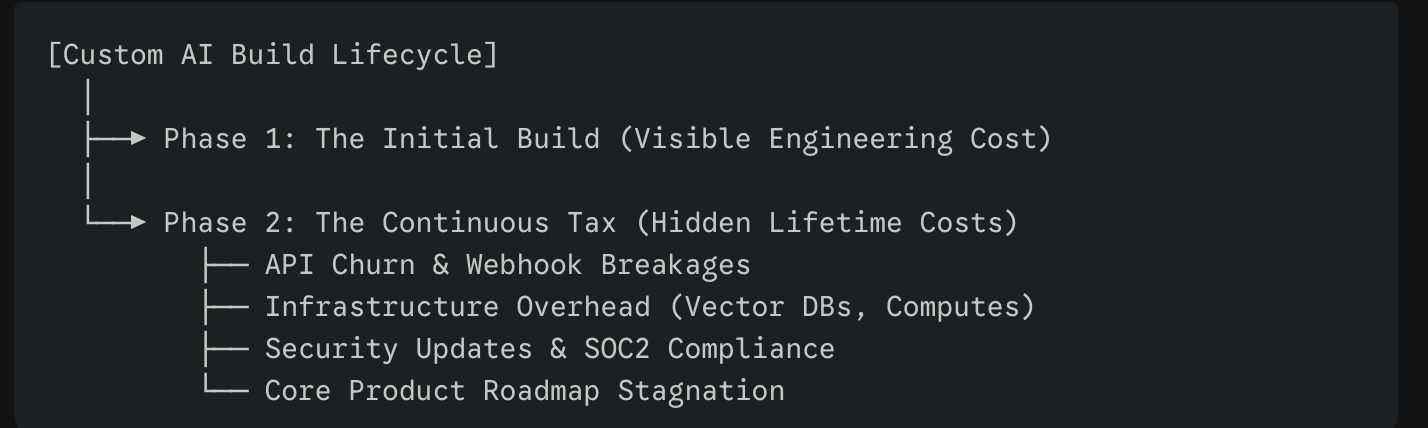
Software code is often discussed as if it were a physical asset—like a building or a machine that, once constructed, stands indefinitely with minimal upkeep. In reality, enterprise integration software behaves much more like plumbing in an earthquake zone. It is under constant, unpredictable stress from external forces.
Your company's digital ecosystem relies on dozens of third-party SaaS vendors. Salesforce, Slack, Hubspot, Jira, and Google Workspace are constantly evolving. They update their public APIs, deprecate old endpoints, modify webhooks, and adjust their security protocols to combat changing threat landscapes.
Every single time an external vendor pushes an update, your custom-built AI connector is at risk of breaking. If a developer at Jira changes how a sprint blocker is tagged in their data payload, your internal LLM tool will suddenly stop recognizing project delays. If Salesforce updates its OAuth authentication flow, your custom data pipeline goes completely dark.
This creates the "AI Plumber" dilemma. Your top-tier software engineers—individuals hired to build your core, revenue-generating commercial product—are suddenly transformed into digital maintenance workers. They spend their weeks tracking down broken webhooks, rewriting API logic, and debugging data ingestion pipelines just to keep the internal AI running. You are paying premium engineering salaries for infrastructure plumbing that provides zero competitive advantage to your core business.
Beyond the human capital required to maintain the code, the underlying physical infrastructure of a custom enterprise AI engine comes with an aggressive price tag.
An LLM cannot simply read an enterprise data stack out of the box; the data must be continuously extracted, cleaned, embedded, and stored in highly specialized vector databases to allow for real-time semantic searching.
When a company buys an enterprise-grade platform like Jigso, these infrastructure costs are optimized, absorbed, and managed at scale by a dedicated platform. When you build it yourself, your finance team has to brace for a highly volatile, unpredictable cloud infrastructure bill every single month.
In the modern corporate landscape, data security is non-negotiable. If your company holds a SOC2 certification, complies with GDPR, or operates within regulated industries like finance or healthcare, an internal AI tool cannot be treated as a casual internal project.
To pass a security audit, your custom AI infrastructure must prove that it can handle data with absolute integrity. You must build complex audit logs showing exactly who queried what data, when they queried it, and how that data was processed. You must ensure that data is encrypted both in transit and at rest, and that no corporate intellectual property is inadvertently being used to train public, third-party AI models.
Furthermore, as discussed in our previous post, your system must perfectly mirror the complex user-level permission matrices of your underlying platforms. If your internal build takes months to clear your security team's governance hurdles, your time-to-value drops to zero, and your organization falls further behind competitors who opted for a deployment-ready solution.
The most expensive aspect of building a custom AI infrastructure is the one that never shows up as a direct line item on a profit and loss statement: opportunity cost.
Every hour a senior software architect spends configuring an open-source MCP server, fixing an internal data connector, or writing compliance documentation is an hour that was stolen from your core commercial product roadmap.
You must ask yourself a fundamental strategic question: Is our company’s core value proposition built on being an enterprise AI infrastructure integration provider? If the answer is no, then spending your limited engineering capital to build that infrastructure internally is a misallocation of resources.
This is why the market is experiencing a massive shift away from custom AI builds toward purpose-built platforms like Jigso. Buying Jigso isn’t just about avoiding an engineering project; it’s about shifting your entire operational paradigm.
Instead of investing hundreds of thousands of dollars to build an internal tool that requires constant maintenance and merely sits in a chat box waiting to be asked questions, organizations can deploy Jigso instantly. Jigso provides out-of-the-box, secure, permission-aware connectors to your entire software stack.
More importantly, it moves your organization past the limitations of simple data collection. It functions as an autonomous, proactive intelligence layer—a digital Chief of Staff that actively monitors your corporate data fabric, isolates critical business trends, and surfaces the exact signals your leadership needs to run a proactive enterprise.
Stop paying the custom AI tax. Let your engineering team focus on building what makes your company unique, and let Jigso handle the intelligence layer that keeps your business ahead of the curve.


